SEARCH RESULTS FOR:

Search Results

University of Kentucky College of Social Work to host KASWE Spring Conference 

Lexington, Ky – The University of Kentucky College of Social Work (CoSW) is set to host the Kentucky Association of Social Work Educators (KASWE) 2024 Spring Conference. Kicking off National Social Work Month on March 1st, the theme for this Spring’s meeting will be, ‘Social Work is Everywhere’. 

KASWE offers a fall and spring conference hosted by a member school, with members from accredited academic institutions with social work programs across the state. The spring conference provides a forum for social work students and educators to showcase their accomplishments and network with others in the field.  

Dr. Kalea Benner, Associate Dean for Academic and Student Affairs said, “We are thrilled to be hosting KASWE in the heart of Lexington, where knowledge meets compassion. Join us as we celebrate ‘Social Work is Everywhere’ uniting educators, students, and practitioners in the pursuit of a brighter, more compassionate future.” 

All persons who are directly involved in the academic education of social workers and those directly, and/or primarily involved in the experiential education of social work practitioners are invited to attend. 

Undergraduate and graduate students working with faculty on any type of scholarly endeavor within their discipline will present their work as poster presentations. Presentations can reflect independent research projects, submissions that reflect experiences of social work education research, community engagement, internships, education abroad, and/or other related academic experiences are welcome. 

The conference will be hosted in the William T. Young Library on the University of Kentucky Campus from 8am – 4pm Friday, March 1st.  

For more information, click on the button below.

Investing in Kinship Families: KY-KINS Provides Individualized Peer Support

LEXINGTON, Ky. – Across the nation, nearly 2.7 million young people are being raised by a relative. This care arrangement, referred to as kinship care, is necessary when parents are unable to safely care for children in their home. It is estimated that Kentucky has one of the highest rates of kinship care in the country. 

And for many of those kinship caregivers, there is great need for support. 

“Kinship caregivers face challenges that are exceptionally unique,” explained Jessica Adkins, a kinship care provider who raised five children; two biological sons and three adopted children, two of which were kinship placed. “The familial dynamics are often strained, and kinship caregivers can struggle to find the resources and supports they need.” 

Enter KKRC. 

To support kinship caregivers, the College of Social Work (CoSW) at the University of Kentucky launched the Kentucky Kinship Resource Center (KKRC) in March of 2020. The KKRC provides a continuum of services to meet the unique needs of kinship providers across the Commonwealth. Those services include comprehensive education and training initiatives, mentor programs, and broad-based advocacy.

“KKRC is particularly situated to meet the needs of the Commonwealth,” Jay Miller, dean of the CoSW, said. “This center was the first of its kind in our state, and we are extremely excited to be able to serve kinship caregivers in an innovative way.”

Among the innovative services offered at KKRC is KY-KINS. 

KY-KINS is an evidence-informed peer support program that matches kinship caregivers with certified Peer Support Specialists. These specialists, all of whom have lived experience as a kinship caregiver themselves, provide individualized support services to kinship caregivers throughout Kentucky. 

“KY-KINS has a singular focus to support kinship caregivers in all aspects of their kinship lives,” said Sheila Rentfrow, KKRC Program Coordinator. “Ultimately, we hope to have a positive impact on the people we are able to serve through the program.”   

Certainly, that impact has shown through. 

Reports show KY-KINS has increased caregiving capacity, reduced stress, and offered increased stability to Kentucky families. In 2023, KY-KINS was nationally recognized and named “Parent Group of the Year” by the North American Council on Adoptable Children (NACAC). The award is designed to honor parent associations and groups for their excellence in supporting adoptive, foster and kinship families. 

More recently, KY-KINS was approved to certify kinship peer supporters, in accordance with Kentucky law. The program is recognized as meeting state certification requirements — allowing KKRC to address critical workforce and behavioral health needs in Kentucky.

For many like Adkins, who in addition to being a kinship caregiver is a Certified Kinship Peer Supporter, programs like KKRC can have a significant impact on kinship caregivers – and the young people in their care.   

“As a kinship caregiver, I wasn’t able to access programs like KKRC,” explained Adkins. “For many of our caregivers, it is such a relief to know they are not alone. To know that they are heard. To know that there is help. That is what KY-KINS is all about.” 

Sport Social Work Research Lab: Exploring the Impact of Recreation on Youth Development

LEXINGTON, Ky. – For Tarkington Newman, associate professor at the University of Kentucky College of Social Work (CoSW), a passion for a career working with kids has evolved into research in a relatively new area: sports and social work. This unique intersection can be used to develop life and social skills, and in many cases, social advocacy.

Arriving at the CoSW in the fall of 2023, Newman is also the director of the Sport Social Work Research Lab. Through his core research, Newman is looking at how sport can foster places where learning can occur, particularly related to social justice.

“My research is related to youth development, specifically positive youth development, meaning I take a strengths-based approach,” Newman said. “I am interested in life skills, knowledge and promoting social justice.”

Within that framework, Newman explores how sport can be used to promote healthy development in kids and how recreation can be used to facilitate that. Newman has also coached track & field and cross country for the past 15 years, allowing him to be fully immersed in his research.

“I focus on traditional life skills: teamwork, emotional regulation, self-control, time management and goal setting, as well as social justice life skills, meaning anti-racism, LGBTQ+ advocacy and allyship, healthy masculinity, mental health literacy and how those things can be promoted and learned through participation in athletics,” Newman said.

More recently, Newman has been involved in the collegiate athletic space, looking at not only how sport can be used to promote healthy development in youth and young people, but also identifying the necessary supports and services needed for people within those environments, ranging from student-athletes to coaches and administrators.

Another area of Newman’s research involves the recent resurgence of athlete activism in collegiate athletics and the student-athletes’ feelings of autonomy and self-determination for not only their sport careers, but their life trajectory and life ambitions.

“We’ve seen athletes, especially from historically marginalized populations, begin to leverage their social platform to speak out, whether that’s related to sex and gender, race and racism or even ability,” Newman said. “It’s been cool to watch that and to do some of the research on why they want to get involved and why now is the right time to speak out.”

As for the future of sport social work, Newman understands social work offers a unique perspective in the athletic space, bringing a grounded approach in social justice and understanding systems of inequity. Because social work emphasizes mental and behavioral health, social workers can help get to the root of the presenting problem, such as generalized anxiety, and address it, which may lead to improved performance.

“Ultimately, by understanding what’s going on and what practices sport social workers are using, we can use that information and knowledge to then train the future of social workers to go out into the profession and into those communities and be culturally competent and provide appropriate services,” Newman said. “We are looking at sport social work and advocating for it in all athletic spaces.”

To learn more about Newman’s research and the Sport Social Work Research Lab, please contact Tarkington Newman at tarkington.newman@uky.edu.

University of Kentucky College of Social Work Presents Innovative Research at the 2024 Society for Social Work and Research Conference

WASHINGTON, D.C. – For 85 years, University of Kentucky College of Social Work (CoSW) faculty have conducted cutting-edge research aimed at addressing society’s most challenging social conditions. The impact of that research was on full display at the 2024 Society for Social Work and Research (SSWR) Annual Conference from January 10-14.

The SSWR Annual Conference reflects a broad range of research interests involving over 500 symposia, workshops, roundtable, and paper and poster presentations. This year, CoSW faculty presented over 20 juried presentations, covering an array of topics including health disparities, trauma and family adversities, school bullying, child wellbeing, and the toll of economic stress among single mothers of young children. 

“Research is relationships. In addition to sharing my work with social work scholars, educators, and students, I get to learn about the work that others are doing in my research area,” Dr. Sheila Barnhart, associate professor, shared. “Additionally, I get to learn about novel or lesser-known methods for investigating problems and it helps me generate new questions and ideas, which strengthen my work.” 

As part of the Forward, Together Strategic Framework, CoSW has made substantive investments in supporting research efforts consistent with UK’s Research Priorities Initiative. By piloting these initiatives, the CoSW has made significant strides in supporting the submission of extramural proposals, extending professional development opportunities, and judiciously allocating resources, all key elements of this endeavor. 

And it appears this is paying off. 

Among CoSW attendees was faculty member Dr. Laneshia R. Conner, who was awarded and recognized for her exceptional research achievements during the gathering. Her research, “Black Experiences Matter: Reflections on Black Faculty Interactions with Black Administrators,” was featured in the Journal of Social Work Education in 2022.  

“I hope that our work inspires the academy broadly, and social work education,” Conner said. “I envision this work making long-term impacts on the recruitment, retention, and advancement of Black social work professionals in the academy at all levels.” 

From 2018 to 2023, CoSW’s extramural research funding has grown over 350%. From 2018 to 2022, proposal submissions increased nearly 200%. Faculty scholarship and dissemination activities – such as presentations at SSWR – have also continued to grow. 

You can learn more about SSWR, and see a full list of CoSW presenters, by visiting the SSWR Conference website here.

Foster Parent Mentor Program Q&A: Providing Encouragement Through Mentorship

LEXINGTON, Ky. The Foster Parent Mentor Program (FPMP) at the University of Kentucky College of Social Work specializes in one-on-one, intensive coaching relationships, which provide newly approved foster parents with emotional encouragement, skill reinforcement, and parenting strategies. 

During National Mentor Month in January, mentor Stephanie Spires, along with her mentee Rebecca Ashby, took the time to answer a Q&A about their experiences in the FPMP. 

CoSW: How long have you been working with your mentor and what has been the most beneficial part of working with her? 

RA: I have been working with Stephanie Spires as my mentor for three years. The most beneficial aspect of this has been that Stephanie has had so much experience and many years working as a foster parent in many different situations, and she is able to share wisdom from those with me. Knowing that I can message her anytime to ask a question has been comforting because I do not have many friends or family who have been foster parents. Fostering, DCBS, and the court system is a new world that brand new foster parents get to navigate, and having a mentor who has waded these waters before is enormously helpful. I did not feel alone in this process, or my feelings about it.   

CoSW: How did you become a mentor in the Foster Parent Mentor Program and what do you enjoy most about it? 

SS: Despite all the training, there are so many questions for new foster families. My mentor, Francie Graven, was amazing when I first became a foster parent and answered all my questions, encouraged me, and even provided our family respite. I wanted to support other new foster families like my mentor supported me. 

CoSW: What is one piece of advice that you have learned that you would share with new foster parents? 

RA: I would say to do everything you can to communicate and build relationships with your foster child’s biological family. Be vulnerable, sincere, and open. You can partner with them or help them just as much as you help their child. Be open-minded and flexible, and try to understand what the family’s history, experiences, strengths, and struggles are. Document the little things that your foster child does and the big milestones and share those. Communicate the day-to-day routines and what happens at all appointments they are unable to attend. Things will be easier for the parents, the child, and you if you are able to forge a bond. I tried to share little moments of things my child did that would make them feel close to them.    

CoSW: What is the biggest piece of advice you give to new foster parents? 

SS: I don’t know if it is advice but I typically encourage new foster parents to do respite for different children to learn more about their families’ strengths and weaknesses. Additionally, I reiterate the importance of setting boundaries and self-care.  

CoSW: In what ways has your mentor helped you in your fostering journey? 

RA: Stephanie has helped me by answering questions I have had about court processes and understanding expectations for how the court, in connection with DCBS, functions. Although you learn a bit about this in the fostering classes, how it works, like nearly everything, is something you learn from experience. I know that Stephanie is an experienced parent as well, so I have been able to ask for her advice on aspects of parenting. Just knowing that she is available for me to reach out to is a comfort. Fostering can feel lonely because it is a unique and uncertain journey. Having Stephanie as a mentor has given me a connection and having that connection has offered me peace of mind.   

CoSW: How do you approach helping your mentees with issues they are facing as new foster parents? 

SS: I try to just be accessible. I check in frequently, but really, I want them to contact me when they have questions, needs, etc. regardless of the time. 

CoSW: How did your mentor prepare you for what to expect at placement? 

RA: My mentor was present at some of my training classes and was able to offer insight from the start of what to expect when beginning the fostering journey. She shared some of her diverse experiences and I learned that every case is different. This helped me have an open mind and to expect the unexpected from the start. You have to know what you can control in a situation and what you cannot control. You can control showing love, becoming knowledgeable, learning to advocate, and working tirelessly on behalf of a child. You cannot control what happens in the court, with the first family, the workers, or with any part of ‘the system.’ Stephanie, along with my trainers, stressed valuing relationships with the child’s first family, and this advice was enormously helpful. Before fostering, I am not sure I understood this. After taking the classes and talking with Stephanie, I viewed my work as a foster parent as not just relationship-building with the child but with their first family. We are trying to support families as a whole. This perspective was enormously helpful, and I think the mindset of supporting the first family as a way of also helping my child as much as I could in my role made me a successful foster parent.  

CoSW: Why is having a mentor as a new foster parent so important? 

SS: A mentor is important because it gives the foster parent someone in their corner. The mentor can both mentor from experience but can also be objective when discussing a potential or current placement. 

CoSW: What has been the most rewarding part of being a foster parent so far? 

RA: Building a supportive community around my (now adopted) child was the most rewarding part of being a foster parent. Every person in my child’s life is an important player in keeping them safe, helping them heal, working through obstacles, and becoming the best person they can be. As the foster parent, I felt I was building and maintaining a knowledgeable and loving circle for them. Seeing that I could coordinate efforts to contribute to my child’s development by involving a community of people was rewarding. To watch others love, teach, and care for my child, and knowing that my child could feel that love and support, was a great feeling. Being an advocate for a child with extra needs is exhausting at times and it is a 24/7 job, but I have found nothing more fulfilling, either. You learn the true meaning of “it takes a village to raise a child.” Therapists, doctors, social workers, family, and friends all contribute. To get to be the one to seek resources and advocate for my child, as well as help them form and maintain positive relationships, has been a humbling honor.    

CoSW: What is the most rewarding part of being a foster parent mentor? 

SS: The most rewarding thing is watching these families grow and watching my mentees grow. Many of my mentees have gone on to become adoptive parents. I love seeing their children thrive and grow. Additionally, many of my mentees have gone to become strong public advocates for children and/or mentors and educators for other foster families.  

Seeds of support: Transforming 4-H camps into havens for social, emotional and behavioral health

This story was originally published by UKNow.

Lexington, Ky.— The University of Kentucky Martin-Gatton College of Agriculture, Food and Environment (Martin-Gatton CAFE) and the College of Social Work (CoSW) are spearheading a novel initiative aimed at enhancing social, emotional and behavioral support for children and teenagers. 

The project is part of UK Engage, led by Nancy Cox, vice president for land-grant engagement and Martin-Gatton CAFE dean, and Executive-in-Residence Mary Shelman. UK Engage identifies strategies and priorities for enhancing land-grant engagement across the campus and in Kentucky communities. 

Concerning data about young people’s mental health in the United States highlights the initiative’s urgency. The Centers for Disease Control and Prevention reports that from 2011-2021, 42% of adolescents experienced persistent feelings of sadness or hopelessness while 29% experienced poor mental health in the past 30 days. 

In response, Martin-Gatton CAFE’s Cooperative Extension Service (CES) partnered with the CoSW introducing the 4-H Camp Behavioral Health Fellow Program in 2022. This innovative program focuses on recruiting and training qualified behavioral health professionals and strengthening the ability to effectively address youth health needs. Designed to integrate behavioral health support into the 4-H summer camp experience, the program addresses a crucial gap in campers’ social, emotional and behavioral health. 

Ryley Butler Modaff, the first fellow, says the program is helping youth and families in need. 

“I’ve worked with and helped young people who had mental health issues so they could continue with their camping experience,” said Butler Modaff, CoSW graduate student and inaugural 4-H Behavioral Health Fellow. “I think the program can really help youth positively view behavioral health.” 

Leveraging her academic foundation in social work, Butler Modaff has been instrumental in informing and executing strategies to support young people in addressing health challenges, ensuring they had a fulfilling camping experience. 

The two colleges are the perfect duo for assisting youth with behavior and mental health. 

“We understand that all young people come into 4-H membership with different lived experiences,” said Rachel Guidugli, CES assistant extension director for 4-H youth development.

“Through this partnership with the College of Social Work, we are building capacity to support child development in a neutral space like 4-H Summer Camp. This way, we create a ripple effect into our communities as we prepare a workforce that’s ready to lead.”  

During her camp tenure, Butler Modaff engaged in various activities with the campers. Her responsibilities included handling severe homesickness, managing aggression and resolving conflicts among campers. This approach aided the 4-Hers directly and provided camp staff with insights into effectively managing behavioral health issues. 

“Integrating behavioral health into 4-H summer camps is vital in addressing the mental, social and behavioral healthcare needs of young people and their families across Kentucky,” said Meagan Lederman, CoSW assistant director of strategic operations in experiential learning partnerships. “Ryley’s contributions have been instrumental in shaping this initiative, and we are excited to see its growth and impact.” 

Butler Modaff said the fellowship provided her with invaluable practical experience, enhancing her educational journey. The fellowship program was not only important to the 4-Hers but to herself as well. So much so, Butler Modaff is staying on with the program to help it grow. 

With Butler Modaff’s help, the fellowship program is looking to recruit more CoSW students, offering hands-on learning and professional development opportunities. It aims to place a fellow at each of UK’s four 4-H camping facilities during the summer, ensuring consistent, comprehensive health support. 4-H currently serves over 13,000 individuals from all 120 counties in Kentucky. 

“We want all 4-H camp participants to feel like they belong. We have created a supportive environment where caring adults are engaged in the participants’ individualized pursuits of success,” said Joey Barnard, CES principal 4-H camping specialist. “We care about young people’s physical, emotional and mental health. We aim to create a camp environment that supports youth in that moment and beyond.” 

Fostering Connections: ASK Program’s Support in National Adoption Month

November is National Adoption Month and at the University of Kentucky College of Social Work, the Adoption Support for Kentucky (ASK) program supports foster and adoptive parents daily through trainings and support groups.

ASK is an award-winning program that utilizes innovative training modalities and inclusive support group practices to meet the needs of foster, adoptive, relative, and fictive-kin caregivers throughout the Commonwealth. In FY23, ASK provided training and support to 4,232 individuals, covering foster and adoptive-related topics.  

One of the most important aspects of these support groups and trainings is the opportunity for these caregivers to connect with other parents who have shared experiences as they navigate this difficult but rewarding journey.

“We are all here for connection. That is what the heart and core of ASK is, is for that connection and networking. We’re not alone doing this and that’s what I want people to know,” said Angela Jamison, an ASK Adoptive Parent Liaison (APL).

Jamison, a foster and adoptive parent of nearly 15 years, has had 13 children through her home, with most being long-term placements. She currently has five children in her home that are adopted, including four teenagers and a three-year-old.

A big aspect of Jamison’s training is focused on self-care for foster and adoptive caregivers, particularly around taking care of oneself amidst the chaos of daily life.

“So often we don’t take enough time for ourselves, and I think it’s vital. If we’re not caring for ourselves, we’re doing a disservice for the children in our homes. It is imperative that we make time and make an effort to take care of ourselves. That’s also what ASK is, taking time for ourselves,” Jamison said.

Sheila Minton, an ASK Support Group Leader, echoes the same sentiment in her support groups.

“Take five minutes out of your busy life and do something for you. If your cup is empty, how can you fill someone else’s?” Minton said.

Minton has been a foster parent for over 10 years and has four adopted children, as well as over 30 children, ages 0-6, through her home.

“I’ve been with ASK for five-plus years and I absolutely love it. I love helping people, that’s what I do. Through ASK, you can get a group of foster parents together and talk about the things that are painful, the joy, the tears, the happiness. We get to celebrate each other,” Minton said.

Both Jamison and Minton echoed that being a foster and adoptive parent is one of the hardest but most rewarding journeys. Utilizing the support groups and trainings that ASK has to offer is an opportunity to find support with others who are experiencing similar thoughts and emotions in their daily lives.

The ASK Support Groups and Trainings range from transracial parenting and healing after a foster child leaves your home, to support groups for LGBTQ+ foster and adoptive parents, as well as a support group for foster and adoptive parents of teens. All support groups and trainings offered can be found here.

As future foster and adoptive parents begin their journey, Jamison mentions there is never a perfect time and to trust and give grace as you begin.

“I tell my children every day ‘I choose you.’ I choose you on the hard days, I choose you on the easy days. And I will choose you every day. Every child in the state of Kentucky and around the world, no matter their past, deserves to know that they’re chosen,”’ Jamison said.

During National Adoption Month and every month, ASK continues to provide a safe space for caregivers to continue to grow, learn and connect as they navigate this difficult but rewarding journey, because the kids are worth it.

UK College of Social Work Provide DBCS Workers a Day of Self-Care

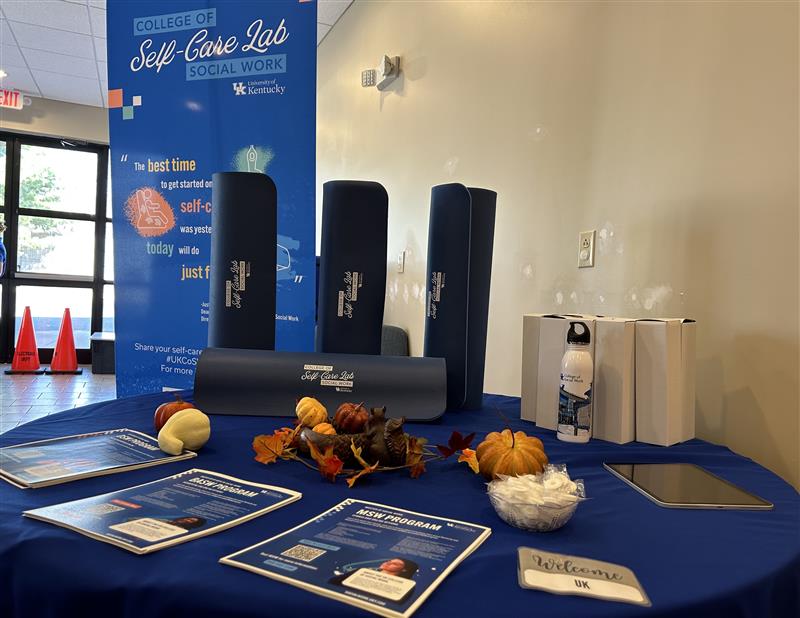
UK CoSW booth
UK College of Social Work booth at DCBS event

The University of Kentucky College of Social Work partnered with the Department of Community Based Services (DCBS) to provide DBCS workers a day to take time for self-care in their busy schedules.

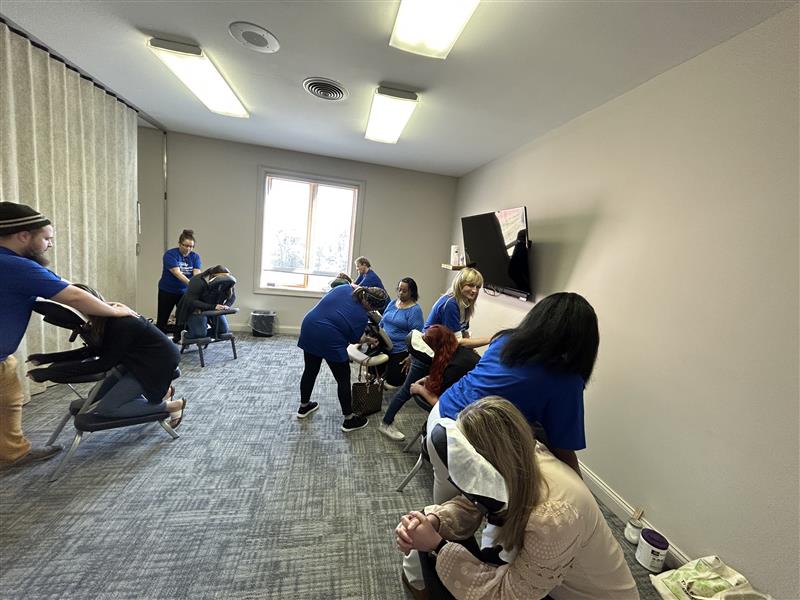
The Southern Blue Taking Care of You Gathering took place on November 8th and 9th at Immanuel Baptist Church. Dr. Jay Miller, College of Social Work Dean, spoke on the importance of self-care on both days of the event, in addition to the CoSW providing chair massages to workers, leading attendees through a virtual reality self-care experiences, and providing complementary Self-Care Lab yoga mats and UK CoSW water bottles.

Making self-care a priority can be instrumental in improving the mental, physical, and emotional health at work and ultimately lead to improved client outcomes. There are many ways to define self-care, but ultimately it is the practice of taking action to preserve or improve one’s own health. 

“Especially being a social worker, a lot of people are relying on you to help them and provide resources to them. It’s so important that you do the same for yourself because if you’re not taking care of yourself like we learned from Dean Miller, then we can’t help the families that need us the most,” said Allie Chapman, a social worker in Jessamine County and UK College of Social Work graduate.

Many social workers, including Chapman, are UK College of Social Work CW Prep (formerly known as PCWCP) alumni who have now moved on to the workforce, working to better the Commonwealth every day.

At the recent event held by DCBS, the CoSW team was able to reconnect with former students of the program and ask them about how CW PREP helped them succeed, as well as what it is they enjoy about working in social work.

“My favorite thing about working for DCBS is honestly the camaraderie on my team, knowing that I’m in the office with a bunch of people with the same mission as me and we all really care for each other. We care to see each other succeed and we’re always there to help each other out,” said Delilah Evans, former CW Prep student.

Being mindful of one’s wellness, especially as a social worker, is a crucial aspect of daily life. Practicing self-care enhances life in and out of the office and improves client outcomes. The best day to start self-care was yesterday, but today will do just fine.

UK Social Work Student Raven Whitaker-Smith Highlights Her Journey for National Adoption Month

This article was originally shared by the DCCH Center for Children and Families Facebook page.


During National Adoption Month, Raven Whitaker-Smith, a junior in the College of Social Work, shared her adoption journey and the impact that foster care has had on her life.

“My name is Raven. I am a junior at the University of Kentucky and I am studying to be a social worker. If you were to observe me from the outside looking in, you would think I had the perfect life. I have two loving parents, three family dogs, all Boston Terriers. I live off campus with two of my friends and have two cats who live with me in Lexington. However, once upon a time not too long ago, my life looked completely different.

The first 11 years of my life were very traumatic. Not every day was bad, but most days were bad. My biological parents were just kids when they had me and my siblings. They were drug addicts, and my home life was a very dark place. I was not safe, I did not feel love, I was neglected and abused. Being the oldest of three siblings, I often got the brunt of the trauma. I tried my best to shield my siblings from the daily abuse and neglect. I was a child though, so I could only do so much.

When I was 11, the Department for Community Based Services (DCBS) finally stepped in and removed us from that terrible environment. Then, I thought that was the worst thing in the world to happen, but it turned out to be my saving grace. I was separated from my siblings because the trauma I faced made it impossible to find a placement for me with them. I stay connected with them.

If you would have told 11-year-old me that I would be a junior in college, she would have laughed you off the planet. Being in foster care completely changed my life. I was placed in Holly Hill Residential Home as an 11-year-old. I attended a Campbell County school. That would place me on a path to meeting the man who would become my dad. I found myself in the principal’s office one day after starting a food fight in the cafeteria. The principal asked me if I would start a food fight if I were out to dinner with my family. When I blurted out that I did not have a family, he said he felt like a complete jerk. I was a foster kid living at Holly Hill. That conversation led him to have a conversation with his wife and the rest is history. I was adopted by them, and that principal is now my dad. Life can be a funny thing sometimes. It’s hard not to believe in fate when you stand back and look at all of life’s little coincidences.

He and my mom went through training and became certified to be foster parents through DCCH Center with the intention to foster me. They could not have kids of their own and something I said that day led them to know in their hearts that I was what their family needed. My mom says she always questioned why she could not have kids until the day she met me. I had never been wanted by anyone in my life. I was a hopeless child who had been discarded by every adult in my life. I did not make life easy on them and sometimes I still don’t. They definitely had to earn my trust and it would take years for them to earn it.

Being fostered by a great set of parents did not erase my trauma, but they provided me with an atmosphere where I learned how to work through it, believe in myself, and gave hope to a hopeless kid.

DCCH Center was the perfect foster agency for me. My case worker, Mel, felt like an older sister and not a social worker. She was young and fun. She would braid my hair, take me for coffee, jump on my trampoline with me and just listen. DCCH matched me up with the perfect therapist. I still see her although now via Zoom since I am in Lexington most of the time. They were there the first day my DCBS social worker introduced me to the Smiths as my foster family and they were there when I was adopted on November 3, 2017. The therapeutic atmosphere that DCCH provided me was what I needed to learn to trust my parents and heal from the trauma I experienced. They are still there for me today even though I have been adopted for almost 6 years. I am doing my class volunteer hours with them and will do my professional internship with them my senior year. I truly feel DCCH is a part of my family and played a significant role in my story.

I love telling people that I was adopted. Not many people get to say their parents chose them. If anyone reading this is thinking about fostering or adopting a child, I urge you to take a chance and try it. I was 12 when I was placed with my parents. Foster care saved my life and because of that, it has inspired me to be a social worker. There are so many kids out there that are just like me when I was 11 who need to be loved, cared for, and given hope.”