
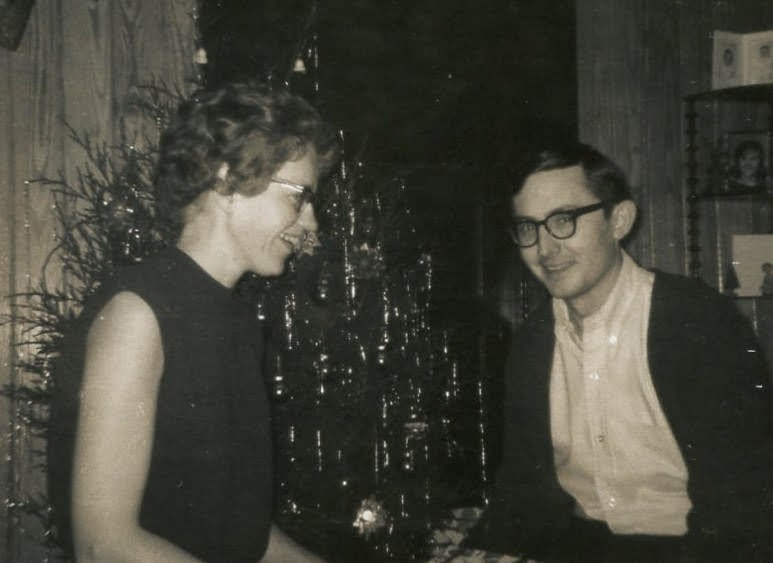
Patsy & Martin Tracy in 1964



Martin and Patsy Tracy’s story begins the way many meaningful lives do: in the space between two people learning how to put their beliefs into words and their words into action.
At the beginning of their story, before there were passports and placements, before there were research programs and systems to reform, there was debate team.
Martin and Patsy met on April 1, 1962, at a debate tournament in Morehead, Kentucky. Patsy was studying at Berea College; Martin was at Murray State. Somewhere between arguments and ideas, they found a shared rhythm. They exchanged information. Then came the letters.
Thin paper folded and sealed, carried across distance between two people bound by curiosity, conviction, and a sense of responsibility to the world around them. Martin kept each one. Patsy wrote fifty-one. In those pages, she offered more than updates; she offered a mind in motion – twenty poems tucked among her sentences, three of them her own, and references to two dozen writers, as if the world itself could be expanded line by line into something truer, kinder, more awake.
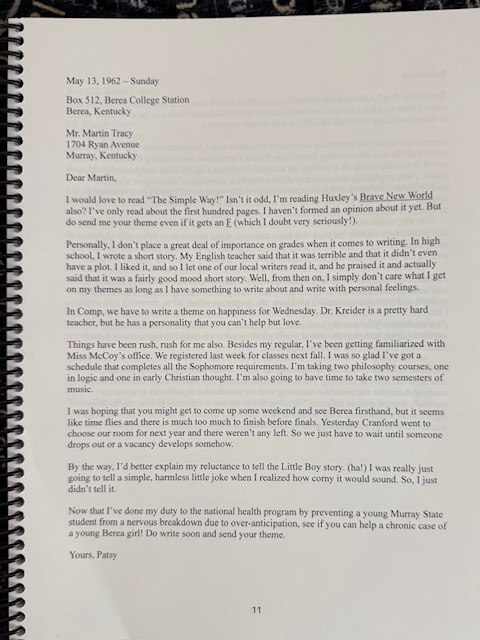
Martin knew early that he had found a partner whose intellect matched her independence. Patsy, driven and self-directed, wasn’t looking to settle down quickly. She once confided she needed seven years before she would even consider marriage. But through writing and a shared pull toward community, social services, and meaningful work, they began to recognize something larger forming between them.
Eventually, Patsy transferred to Murray. In time, they married. And soon after their undergraduate years, they chose a path that would shape the rest of their lives: they joined the Peace Corps.
From 1965 to 1967, Martin and Patsy served together in Turkey.
They did not arrive as experts. They arrived as listeners.
“I spent hours playing dominos,” Martin remembers. The village that welcomed them did not need saving so much as it needed partnership, and this distinction would become a quiet cornerstone of their lives. In cafés thick with cigarette smoke and conversation, Martin learned that development does not begin with blueprints, but with trust.
Patsy watched just as closely. She observed how women cooked, shopped, and stretched limited resources into sustaining meals. She noticed the rhythms of daily life, the unseen labor, and the ingenuity already present. Where Martin built relationships in public spaces, Patsy built them in kitchens, markets, and homes – listening, learning, and noticing where small changes could make a meaningful difference.
They were placed in the Cappadocia region, known for its striking “fairy chimneys” and cave dwellings. Tourism was beginning to grow, but the infrastructure to support it was limited. When local restaurants had no menus, Martin and Patsy helped design them first in Turkish, then in English. When visitors came to see the chimneys and cave homes, they suggested restaurants begin preparing boxed lunches for travelers heading out on long tours.
These were small interventions, almost invisible ones. But they rippled outward. Income stabilized. Confidence grew. And the message was clear: they were not there to change the community’s ways, but to help strengthen what already existed.
It was a lesson they carried for the rest of their lives: people support what they help build.
When they returned to the United States, they brought back more than language skills. They returned with a recalibrated understanding of humility in service. Graduate school followed, not as a pivot, but as a continuation. Martin earned an MA and PhD from the University of Illinois. His work increasingly focused on social protection systems – how nations care for aging populations, support workers, and structure services that uphold dignity.
He went on to serve as a senior research analyst with the Comparative Studies Staff in the Office of Research and Statistics at the U.S. Social Security Administration, and later with the International Social Security Association in Geneva, Switzerland. His work placed him in global conversations about retirement systems, labor policy, and social welfare structures across nations.
Patsy, meanwhile, continued building bridges in the spaces around him. She taught English as a Second Language to students whose futures depended on fluency. Her classrooms were more than academic, they were cultural onramps. She helped newcomers learn not only grammar, but the subtleties of belonging, drawing on her own experiences adapting to life in Turkey.
In Geneva, when Swiss regulations made formal employment difficult, she did what she had always done: she created her own opportunities. She advertised, gathered students, and began teaching independently. Where systems closed doors, she opened windows. Where formal pathways were limited, she built informal ones. Again and again, she ensured that the people around her were seen, supported, and connected to resources.
In 1982, Martin began his academic career at the University of Iowa, where he became professor and director of social work programs. He later held the same leadership role at Southern Illinois University Carbondale, guiding the growth of programs that connected research, policy, and practice. His scholarship and administrative leadership focused on strengthening how social services systems functioned and how research could inform real-world care.
Patsy’s path during those years ran alongside his, just as purposeful. She earned her LCSW and later trained in art therapy, working with survivors and individuals navigating addiction, trauma, and mental health challenges. Funding was often scarce. Creativity was not. Programs were built from conversations, not assumptions. Grants were won through storytelling and demonstrated need. She saw the people behind the challenges they faced and made sure they were not overlooked.
Together, they kept returning to the same principle: community should be the author, not the audience.
From 1999 to 2008, Martin served as a consultant to the International Labour Office in Budapest, contributing to a major project aimed at strengthening social services and civil society across eight countries in Southeastern Europe, including Albania, Bosnia and Herzegovina, Bulgaria, Croatia, Macedonia, Moldova, Romania, and Serbia and Montenegro. In 2004, he was named a Fulbright Senior Specialist at the University of Bucharest. His career also included recognition as a member of the National Academy of Social Insurance and a Fellow of the Genealogical Society of America.
In 2001, he returned to Kentucky to serve as Associate Dean for Research at the University of Kentucky’s College of Social Work, a role he held until his retirement in 2004. There, he focused on building research infrastructure that connected faculty and students, inquiry and practice, and policy with the communities it was meant to serve.
Patsy remained deeply engaged in the communities they called home. Whether through teaching, counseling, volunteering, or organizing, she had a way of noticing who was missing from the room and finding a way to bring them in. She did not need to be at the center to be a leader; she worked from the edges, making sure the systems they helped build never lost sight of the people they were meant to support.
Even in retirement, service did not recede. In Murray, Kentucky, they joined civic clubs, United Way efforts, Rotary, environmental initiatives, and church-based outreach. Patsy’s impact in community life was widely recognized, including being named State Newcomer of the Year for her engagement and leadership. Their commitment to the Commonwealth endured in tangible ways through the creation of the Martin Booth and Patsy Dills Tracy Scholarship at the University of Kentucky College of Social Work. The scholarship supports undergraduate and master’s students from rural Kentucky counties with populations under 100,000 who are engaged in research aimed at improving quality of life for rural Kentuckians. It also supports doctoral students studying social services or income support systems in rural communities in the United States or abroad, particularly those preparing for careers in social work education.
Later, as their needs changed, they relocated to Orlando, Florida, to be closer to family, carrying with them the same ethic of service and civic responsibility that had defined every place they called home.
Ask them what sustained this lifetime of engagement, and they do not point to titles or accolades. They speak of parents who modeled civic duty. Mentors who nurtured curiosity. Early jobs that taught respect for work and for people. They speak of humility, of “good practices” rather than “best practices”, and of resisting the urge to arrive with answers.
Service, for the Tracys, was never a performance. It was a posture.
And perhaps that is the truest arc of their story: not a climb toward prestige, but a widening circle of care—drawn again and again around whoever stood in need of partnership.