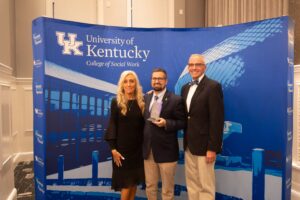



LEXINGTON, Ky. – University of Kentucky Criminal Justice student Spencer Payton has been named the 2026 recipient of the Maurice A. Clay Award for the University of Kentucky College of Social Work (CoSW).
The Maurice A. Clay Award recognizes one outstanding graduating senior from each academic college at the University of Kentucky. Recipients are selected by college leadership based on academic excellence, leadership and impact.
Payton was nominated by CoSW faculty members Stephanie Quiring, J.D., Ph.D., and Nicole McKenna, Ph.D., for his dedication to undergraduate research.

Through his work, Payton has explored complex issues at the intersection of mental health and the criminal justice system. His research with Quiring focuses on mental health and police power, while his collaboration with McKenna examines child sexual abuse organizations, levels of trauma and reentry experiences.
“Over the weekend, I had the privilege to be awarded the Maurice A. Clay Award for the University of Kentucky College of Social Work,” Payton shared. “This award is such an honor, and I am incredibly grateful for the support of my professors, family and peers throughout my academic journey.”
In addition to his research, Payton is a member of Kappa Alpha Pi, a pre-law and government fraternity, and currently serves as the fundraising chair. He is also a member of Phi Beta Kappa, and has previously served for the Wildcat Wardrobe. Payton also completed prior research with Dr. Richard Waterman, focusing on the American Presidency.
Following graduation, Payton plans to take a gap year before attending law school, with the goal of continuing his research and presenting his work at national conferences.
The Maurice A. Clay Award, named in honor of a longtime University of Kentucky leader and advocate, celebrates students who exemplify the values of scholarship, leadership and service across the university.
For the College of Social Work, Payton’s recognition reflects the impact of student-driven research and the importance of preparing future leaders to address complex challenges in communities.