SEARCH RESULTS FOR:

Search Results

UK College of Social Work’s Dr. Allison Gibson Named Fellow for the Gerontological Society of America

Allison Gibson, Ph.D. associate professor at the University of Kentucky College of Social Work and affiliate faculty at the University of Kentucky College of Public Health Graduate Center for Gerontology, has been named a Fellow of the Gerontological Society of America (GSA).

Gibson, a graduate of The Ohio State University, is an expert on aging, mild cognitive impairment, and Alzheimer’s disease and related dementias (ADRDs). Her research focuses on testing psychosocial interventions for persons living with Alzheimer’s and related dementias, as well as with their family caregivers.

“I am honored to join the ranks as a GSA fellow,” said Gibson. “Many of the GSA mentors and colleagues I admire have also been recognized for their outstanding work in gerontology. It is such a privilege to be acknowledged among these exceptional scholars.”

Gibson’s current projects include a pilot study of a telehealth-based program for rural caregivers adapting their home environments for adults with ADRD, a novel social work and music therapy telehealth framework to promote older adult wellbeing, and the development of a state-of-the-art clinical trial infrastructure within the Alzheimer Clinical Trial Consortium.

“We are proud of the outstanding work Dr. Gibson has done, and will continue to do, as a researcher in the field of gerontology,” said Jay Miller, dean of the College of Social Work. “Being named a GSA fellow is a wonderful recognition of her research and we — as an institution — look forward to continuing to support that research.” 

The Gerontological Society of America, founded in 1945, is a multidisciplinary organization devoted to research, education, and practice in the field of aging. Fellow status is the highest class of membership within the GSA society.

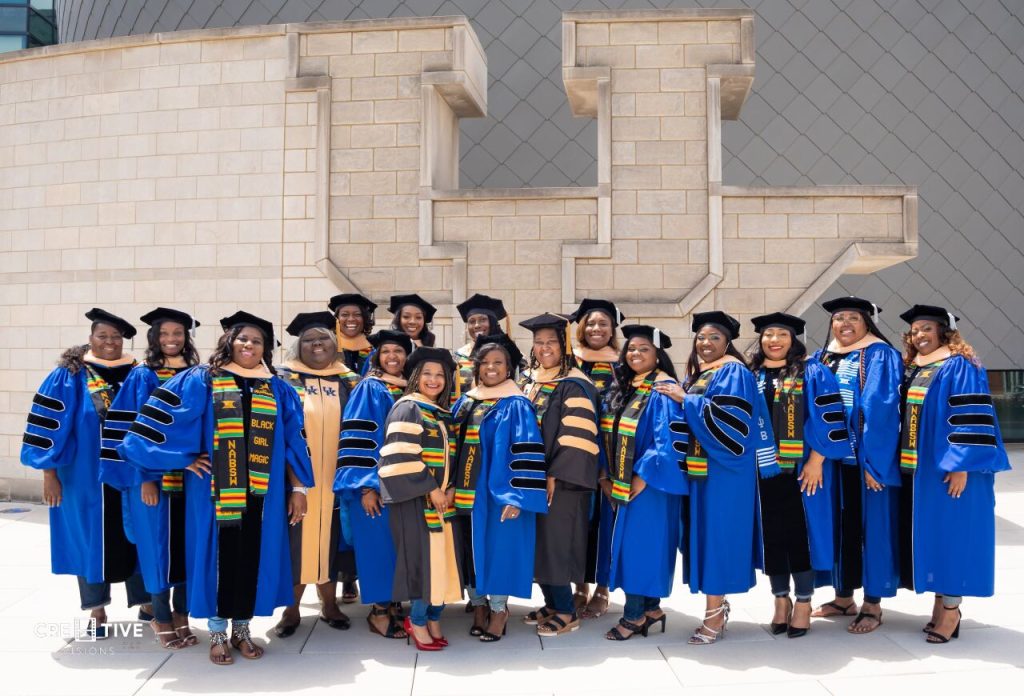
Meet the Social Work Graduates Making History at the University of Kentucky

This story was originally published by LEX18.

Caps and gowns are on, and it’s time for 2022 graduation photos.

But behind these Wildcats’ celebratory smiles, there are stories of perseverance.

Dr. Shericka Smith is a member of the inaugural class of graduates from the University of Kentucky’s Doctor of Social Work Program, or DSW.

“I’m not really supposed to be here,” she said. “According to society, according to statistics, according to what everybody else thinks, you know what Black women are supposed to be or supposed to look like, or not supposed to be, or not supposed to look like. That’s what makes me the most proud.”

Dr. Smith is proud because she and her peers are members of a ground-breaking group. Within their class is the most Black doctors to ever graduate from a single discipline at UK.

“We literally made history,” said Dr. Sharrion Brown. “And that’s not something I’m used to. I’m the first person in my immediate family to graduate college, let alone get this far.”

Dr. Brown and Dr. Smith joined some of their fellow graduates at the student center last week to talk to LEX 18 about their accomplishments. We met women like Dr. Marilyn Lucille Sails, Dr. Cerenity Leavell-Barker, Dr. Angela Williams, and Dr. Cynae Adams.

They all graduated from the online program in two years, meaning they went to school full-time while working. Many of them are also parents.

“I have two children, so I hope one day they can see this and think they’re proud their mother was a part of this,” said Dr. Brittany Gentry.

According to UK, 23 of the program’s 72 graduating doctorate students are Black, including three Black men. Its representation professors say will make a difference in a field that’s historically made up of white women.

“It’s hard to become what you don’t see,” said Dr. Laura Escobar-Ratliff, the DSW program director. “And we are providing opportunities for children to see themselves.”

“We deal with diverse communities,” said Dr. Jay Miller, the dean of the College of Social Work. “And it is extremely important practitioners reflect those communities.”

A 2017 survey from the National Association of Social Workers found nearly 70% of social workers are white. Dr. Gentry says those disparities are part of the reason she enrolled in the program.

“The need for people of color as therapists, as mentors, as case managers, has increased significantly,” she told LEX 18.

To many of the graduates, the title of “Dr.” still feels surreal. But they hope the two letters on the front of their names inspire future students who also want to make a difference.

“We see things on TV, about, ‘Oh this is history-making, people make history.’ And to actually be a part of making history, it’s once in a lifetime,” Dr. Smith said.

UK College of Social Work Study Examines Effects of Mental Health Literacy in Women Affected by Postpartum Depression

Results of a new study from the College of Social Work at the University of Kentucky suggest increased mental health literacy and decreased perceptions of stigma can improve professional help-seeking in women experiencing postpartum depression. The study is published in Maternal and Child Health Journal.

Using self-reported data from 326 postpartum women in the US collected through Facebook and Reddit, researcher Aubrey Jones, PhD, of the University of Kentucky College of Social Work found that nearly 44% of participants had previously been treated for depression and 32.8% of participants had sought treatment since the birth of their child. Results of the study indicate that individuals with higher levels of perceived stigma are less likely to view professional help-seeking favorably. However, individuals with higher levels of mental health literacy are more likely to have a favorable attitude towards professional help-seeking. Favorable or unfavorable views of professional help-seeking can impact the likelihood that a woman experiencing postpartum depression seeks out and acquires treatment.

“I conducted this study because I have witnessed so many women deal with postpartum depression while being told it was normal,” said Dr. Jones. “Postpartum depression is common, but it shouldn’t be ‘the norm’ for mothers. We often have an exaggerated idea of what postpartum depression ‘looks likes’ but postpartum depression can be more subtle and manifests differently for each person and that can create confusion for parents.”

“While the participants in this study identified as women/mothers,” she continued, “it is important for everyone to know and understand that postpartum depression can affect all parents and to talk with your doctor or a mental health provider about your adjustment to parenthood.”

About the UK College of Social Work

For over 80 years, the University of Kentucky College of Social Work has been a leader in social work education. Our mission is clear: Through rigorous research, excellence in instruction, and steadfast service, the College works to improve the human condition. Always, in all ways. To learn more about the College of Social Work, visit socialwork.uky.edu/portal/sw/.

Media Contact

Crystal Barnes
crystal.barnes@uky.edu
859-257-7251

UK Social Work Grad Aims to Help Kids Win on the Wrestling Mat and at Life

This article was originally published in UKNow.

In life, there are wins and losses.

A win doesn’t always equal success. And a loss doesn’t necessarily equate to failure.

Instead, Tyran Price believes it’s what we gain from those experiences, and how you use them to learn and grow, that defines true victory.

Growing up on the South Side of Chicago he would watch, often feeling helpless, as unsolved problems became compounded — creating layer upon layer of troubles for other adolescents around him.

“Where I’m from, a lot of kids like me don’t make it to 18.”

That pain inspired purpose.

From a young age, Price knew he wanted to do more, be more — for himself and others.

As he navigated his teen years, then became a young adult, that desire to be a catalyst for change never subsided.

So, Price turned to education.

“I wanted to work in the field of juvenile delinquency — bring about change for those in the system,” he said. “I thought law school was the answer, so I took all the necessary steps to go.”

Price graduated with a bachelor’s degree in criminal justice from Iowa State University prepared to embark on “the plan” — until he began to question everything.

“I really thought about it and wondered, ‘can I change the mindset of youth by being a lawyer?’ And that’s when I really dug into social work.”

****

Price wanted to pursue a master’s degree at a university that would foster his passion to help troubled youth. Upon researching the Master of Social Work (MSW) program through the College of Social Work at the University of Kentucky, Price knew he had found that place.

“I was drawn to the program through Dean Miller,” he said. “Having a Black man in a position of leadership, I thought, maybe here I can learn how to expand myself and grow from a diverse group of people.”

Following his intuition, Price applied, was accepted and enrolled into the program — a decision he quickly realized he wouldn’t regret.

“My first class, I was sitting there thinking, ‘whoa,’ he said. “I just absolutely loved it.”

The rigorous MSW program includes options for an advanced-standing program (30 credits) and a regular standing program (60 credits) to give experienced social workers and passionate newcomers alike the practical skills needed to be effective in the field. The program is open to all undergraduate degrees and may be completed full-time or part-time, in either a hybrid or online format.

MSW students have the option to earn specialized certificates in clinical social work, child welfare, military behavioral health, rural population wellbeing, integrative behavioral health and substance use disorder, to name a few.

The MSW graduates have the highest clinical licensing pass rates in Kentucky and routinely score above the national average — making those who complete the program uniquely poised to enter a competitive job market. And in so doing, students will positively impact the lives of individuals, groups and communities around the world.

****

Throughout his time in the program, Price pursued the ultimate balancing act — applying himself in the classroom and in the community.

“I interned and worked at a family care center, interned at the Audrey Grievous Center and I’m the assistant wrestling coach at a local high school,” he explained. “Right away I connected with all the kids.”

Just as Price refused to let unfairness and inequality pin him down, he takes pride in helping Frederick Douglass High School students build confidence on the mat and in life.

“When a kid is upset, I have the awareness to say, ‘don’t worry about practice — let’s talk, and tell me what’s going on in your personal life,’” he said. “And it’s helped me be a better coach and a better person.”

As Price prepares to cross the Commencement stage with his master’s degree, he will use his UK education and experiences as he continues his never-ending pursuit to create change. 

Price doesn’t claim to have the solutions to every problem facing today’s youth. But he knows those kids — the ones who have been overlooked and underestimated — are worth fighting for.

“I didn’t grow up in the suburbs with a rich family. I had to tell myself to stay committed, go to school,” Price said. “Now, I just use wrestling as a tool.”

A tool to achieve the ultimate goal — helping the younger generation understand you are not defined by wins and losses.

“This world is so much bigger than your worse problem. You’re bigger than that moment.”

Rosenstein Lecture to Feature Award-Winning Journalist Marc Lamont Hill

This article was originally published in UKNow.

On Wednesday, May 4, the University of Kentucky College of Social Work (CoSW) will hold the 20th Annual Irma Sarett Rosenstein Lecture starting at 8:30 a.m. in the Gatton Student Center.

Additionally, the lecture will be part of the 2022 UNITE Research Showcase, which is centered around elevating and promoting the importance of racial equity research at UK, across the Commonwealth and beyond. The lecture and showcase are open to UK faculty, staff, students, affiliates and academic partners. While the event is free, registration is required for all attendees.

The lecture is named for Lexington social worker Irma Sarett Rosenstein. She led the fight against social injustice in Central Kentucky until her passing in 2015. The lecture, intended to celebrate Rosenstein’s remarkable legacy, will feature one of the leading intellectual voices in the country.

Marc Lamont Hill, an award-winning journalist who currently hosts BET News and serves as a political contributor for CNN, will present the distinguished lecture. He is the Steve Charles Professor of Media, Cities, and Solutions at Temple University. Hill’s research focuses on intersections between culture, education and politics in the U.S. and the Middle East.

Since his days growing up in Philadelphia, Hill has been a social justice activist and organizer. He is a founding board member of My5th — a non-profit organization devoted to educating youth about their legal rights and responsibilities. Hill is also a board member of the Philadelphia Student Union.

Additionally, he works closely with the ACLU Drug Reform Project — focusing on drug informant policy. Over the past few years, Hill has actively worked on campaigns to end the death penalty and to release numerous political prisoners.

Hill has received numerous prestigious awards from the National Association of Black Journalists, GLAAD, and the International Academy of Digital Arts and Sciences.

Ebony Magazine has named him one of America’s 100 most influential Black leaders.

“We are extremely grateful to the Rosenstein family for their supporting what is sure to be a dynamic lecture by Dr. Hill,” Jay Miller, dean of the CoSW, said. “The Irma Rosenstein lecture series encapsulates all that is social work, and we look forward to continuing to being these experiences to our UK community for many years to come.” 

More information and a full agenda is also available on the event website.

About Irma Sarett Rosentstein

Rosenstein graduated from the University of Pennsylvania with a master’s degree in social work. She always cared deeply about the welfare of children, the most vulnerable population. Rosenstein was a social worker at the UK Chandler Hospital and taught in the College of Social Work where she worked closely with the first dean of the college, Ernest Witte. She brought an ethos of openness and clarity to community problems.

Rosenstein did not shirk from addressing racism. She was the driving force behind the Kentucky Conference of Christians and Jews, now called the Kentucky Conference for Community and Justice (KCCJ), an organization dedicated to building community and ending bigotry. Rosenstein hosted one of social work’s most prominent leaders, Whitney Young, at a KCCJ dinner when no public places outside of UK were desegregated.

Thanks to a generous gift from Rosenstein and her family in 2002, the College of Social Work has been providing research-based and practice-driven lectures by distinguished national speakers each year on UK’s campus.

“We appreciate the foresight of Irma Rosenstein to know the importance of bringing experts to our campus to interact with students, faculty and staff,” Miller said. “She left a lasting gift to the college by providing resources to support a lecture series that now carries her name.”

UK Social Work to Hold Ceremony for Army MSW Graduates

This article was originally published in UKNow.

On Friday, April 15, the United States Army and the University of Kentucky College of Social Work (CoSW) will honor 24 graduating officers during a ceremony at Fort Sam Houston in San Antonio, Texas.

Last week, the graduates successfully completed the Army-University of Kentucky Master of Social Work (MSW).

“As a land-grant institution, our commitment to armed forces education is codified via federal legislation,” Jay Miller, dean of the CoSW, said. “Our college is extremely proud — and honored — to actualize this commitment via our Army MSW program. These successful graduates are the embodiment of that commitment.”  

In October 2016, the CoSW established a partnership with the Department of Defense (DoD) to offer a one-of-a-kind master’s degree.

A satellite site was founded within the Army Medical Department Center and School at Fort Sam Houston. The satellite implements the full-time, 60-hour CoSW program. The curriculum is delivered in a condensed format over 14 continuous months of study, and all classes are administered through the Joint Base San Antonio-Fort Sam Houston campus. The goal is to develop well-qualified clinical social workers to fill positions across military service branches.

“In a time of shrinking resources and personnel reductions, many military specialties are being reduced. However, the need for uniformed Army social workers has grown. As a result, the DoD continues to request the Army-UK MSW program increase the number of social workers we develop each year,” Dexter R. Freeman, assistant director of the Army-MSW program, said. “As the program continues to grow each year since partnering with UK, the need to expand our role as producers of military-focused research has also increased. Ultimately, adding value to our partnership with a R1 university such as UK.”

Dean Jay Miller, Colonel Jill Henderson, the UK Army MSW program director and social work consultant to the Army Surgeon General, and Senior Associate Provost Katie Cardarelli will speak at the graduation. 

A reception will follow at the Army Medical Department Museum.

For more information about the Army-UK program, please visit the CoSW website.

UK Social Work Program for Kinship Caregivers Expands to Support More Kentucky Families

This article was originally published in UKNow.

A program that aims to connect and support kinship caregivers from across the Commonwealth is expanding.

As of April 1, the Kentucky Kinship Information, Navigation and Support Program (KY-KINS) housed in the College of Social Work (CoSW) at the University of Kentucky is available in the Southern Bluegrass Service Region and the Two Rivers Service Region.

Now, families in 62 Kentucky counties will be able to access the much-needed resource.

“Without question, Kentucky’s kinship providers need access to a diverse array of innovative services,” said Jay Miller, dean of the CoSW. “Expanding this program will allow our college to serve more of these caregivers — and in turn — positively impact the youth in their care.” 

More and more family members are providing safe homes to children of parents struggling with substance use disorder and mental health issues.

There are immense benefits of kinship arrangements — a form of care that allows children to grow up in a family environment. Studies show these children have healthier behavioral and emotional outcomes. But emerging research also takes a closer look at the struggles relatives often face when caring for young family members.

Data suggests that kinship rates throughout the state are among the highest in the country. In an effort to provide much needed support for these families, in March 2020, the CoSW launched the Kentucky Kinship Resource Center (KKRC).

In September of the same year, in collaboration with the Kentucky Cabinet for Health and Family Services (CHFS), the college went a step further — launching the KY-KINS in the Salt River Trail Region and Cumberland Region. 

The program was established with one critical goal in mind — to connect kinship caregivers from across the Commonwealth with an array of services designed to meet their unique needs.

“KY-KINS is designed to provide a strong social support network easily accessible by participants in times of need,” Missy Segress, director of centers and labs in the CoSW, said in a previous UKNow release. “Through our innovative partnership with CHFS, we have implemented a program that will reduce the risk of placement instability among kinship providers and improve the quality of care provided.”

Additionally, families being served by KY-KINS can have access to innovative peer support and mentoring initiatives. Kinship Peer Supporters, who are caregivers themselves, undergo comprehensive training to provide the best support possible.

KY-KINS is based on the premise that by connecting kinship caregivers to a supportive network, the overall well-being of the entire family will improve, and the placement of children in the home will become safer and more stable.

Ultimately, young people need caregivers, and caregivers need support. 

This KY-KINS expansion aims to be that support by striving to ensure all current and prospective kinship caregivers are connected with resources and services they need.

“We are driven to serve in a manner that is consistent with the land-grant mission of the university,” Miller said. “We will continue to grow our programming until such time that every relative caregiver has access to the services they need.”

To learn more about KY-KINS, you can watch this video. For additional information about KY-KINS, email kinship@uky.edu or text KINSHIP to 31996.

Tamara Vest grew up in foster care. Now, she’s working to improve the system

This article was originally published by Spectrum News 1.

Adversity is a word with which Tamara Vest is all too familiar. 

Vest, 25, a Lexington native, aged out of Kentucky’s foster care system when she was 17. She describes her childhood as “rough” and said “the odds were stacked against” her. 

University of Kentucky public relations officer Lindsey Piercy has been writing about Vest and following her story for several years. Piercy reported that Vest was 9 years old when her father died of cancer. Vest said she remembers being carried out of the funeral home because she refused to leave. Her mother could not care for her because of an ongoing battle with drug addiction. 

“It’s always something I struggle with,” she said. “It hurt me when I was a child. But I never really completely understood the loss until I was older.”

After multiple lengthy court proceedings, Vest was placed in the care of her older brother. She described his household as “tumultuous” and recalls wishing she had been placed somewhere else. 

“Going through just about every kind of abuse you could imagine as a young child and teenager was extremely hard,” she said. “Even though they were my kin, I felt unwanted and unwelcome. I hated to go home, and school was an escape. I was scared to speak up in fear that it might make the situation worse, or that I would end up in foster care — ironically.”

Vest eventually informed the counselors at her school about the prolonged mental and physical abuse she had been enduring. She was 16 years old when she came home after school and was told to gather her belongings. After doing so, her brother took her to a homeless shelter. 

“My brother decided he didn’t want to take care of me anymore,” she said.

She spent two months living at Arbor Youth Services before being placed in a foster home. A social worker told Vest about the only home in Lexington that fostered teenagers.

“It seemed there was a lack of wanting to foster children over a certain age,” she said. “Regardless of age, you never outgrow the need for someone to care about you, for someone to love you and for a family. I felt like I would never have a family of my own. I felt like I would never be accepted for who I was, and I certainly felt like my existence was a dollar sign.”

After living in the foster home for nearly a year, Vest said she was tired of being used. She was 17 years old when she signed up for a program that provided an apartment. While technically still a child, she said she embraced her new lifestyle. Doing so, instilled in her confidence and independence. She received rental assistance and a grocery stipend on the conditions she attend school full time, work full time, or do both part time.

“It was hard, because I didn’t have any support. I had to teach myself how to cook. I also could never get my permit or driver’s license,” she said. “I faced challenges in being able to advocate for my needs and meet my needs.”

After being “fed up with the system,” she said, Vest chose to not recommit to foster care and began a new path by enrolling at Bluegrass Community and Technical College (BCTC) to pursue a degree in political science. Her pursuit of that degree soon changed.

“During my time off, I reflected,” she said. “I thought about the people who brought about positive change in my life — they were social workers. So, I started there.”

THE PATH TOWARD SOCIAL WORK BEGINS

Vest earned her associate degree with a focus on social work from BCTC and in 2018 transferred to the University of Kentucky College of Social Work to continue her education, which is a statistical anomaly for someone with her past, as fewer than 10% of foster youth graduate from college. There were challenges, however, and Vest said UK faculty members Kalea BennerDiane Loeffler and UK College of Social Work Dean Justin “Jay” Miller helped her by being “extremely supportive” and making her feel “worthy and accepted.”

“I believe the flexibility and support of these individuals helped me recognize the strengths within myself to succeed in my undergraduate journey,” Vest said.

During her time at UK, Vest was introduced to Voices of the Commonwealth (VOC) — an organization that advocates for foster youth. Vest agreed to share her story, but soon did work she previously swore she would never get involved in — foster care and child welfare.

“I learned quickly that my experience is vital to creating change for that population,” she said. “As a former foster youth with no support, I relied on my income to support myself. However, my job closed during the first months of the pandemic and unemployment resources were hardly enough to cover food — let alone my rent. As I prepared to graduate, I still feared that everything I’ve worked for could be taken away from me in a matter of seconds.”

Vest was selected as the December 2020 commencement student speaker. She said sometimes in her life when she believed she would not reach the age of 18, and earning her bachelor’s degree at age 23 was “beyond surreal.”

“From my perspective, I think youths in foster care really just need somebody willing to care,” Vest said. “It’s very rare. It sounds like common sense, but there are a lot of times they just feel like they’re not being heard. There’s a societal belief that children don’t know what they’re talking about, but that’s not true. Often, they know what they’re talking about; they know what they want or need. They’re trying to voice that and it’s not being heard.”

LIFE AS A SOCIAL WORKER BEGINS

Vest has worked as the Independent Living Coordinator at Murray State University since October 2021 and she is on track to graduate from UK in a year with her master’s degree in social work. She said her passion is helping teenagers in foster care beat the odds and not feel overlooked or underestimated. 

“I’m an example of someone who came from nothing and made everything for myself,” she said. “It is a long process. It is a hard process, but the results are so worth it. Investing in yourself and your future is never something you will regret.”

There are more than 9,000 foster youths in Kentucky and finding stable homes for placements has become increasingly challenging as social services struggle with an increased number of caseloads, smaller staffs and thinner budgets. The rate of child abuse and neglect in Kentucky remains high. The COVID-19 pandemic had a more significant effect on vulnerable populations, such as the child welfare sector.

Vest worked with several social workers while growing up in foster care and she said those interactions were positive and negative.

“I can speak to the feeling of being burned out and not having enough pay, and just being so stressed,” she said. “I think now that I’ve seen it from an outside perspective, I have been able to understand probably why some interactions I had were negative, but there’s no excuse.” 

Vest said most social workers with whom she dealt helped her and it helped her realize there are many areas in which social workers can work. 

“One of the social workers I interacted with was a therapist, another was a clinician and one worked in schools,” she said. “Obviously, there were others that worked as case managers and things like that. It was just a variety of ways you could help people. As a young adult, I realized that coming out of the foster care system and not having support sets you back. I have to work twice as hard to get where others are. I just wanted to help people that were in the same situation as me and may be set back a little.” 

Vest said she realizes foster care youth is not the only group that suffers setbacks. 

“It could be any population that feels that way or just anyone who just feels like they need a little help to match where other starting lines are. That’s what led me to do social work. I never thought that I would be a social worker. When I left foster care, I said, ‘I want nothing to do with any of that stuff ever again.’ Now, here I am.”

ADDRESSING THE VULNERABLE POPULATION

In response to problems plaguing foster care youth in Kentucky, the UK College of Social Work is using $3.9 million in COVID-19 relief funds to launch the Pandemic Support Response Initiative (PSRI), which aims to serve as a resource connector for foster youths across the Commonwealth. The initiative is geared toward foster youth not unlike Vest once was — those dealing with financial hardships, employment issues, and access to mental health and wellness resources. While there is an array of services and resources designed to assist youth in foster care as they work toward self-sufficiency, PSRI would increase the ability to access support, which is limited. 

“PRSI will support current and former foster youth by connecting them with resources to develop and attain employment skills, sustainable housing and mental and behavioral health services,” according to a press release from UK. “One aspect of the program is a peer-run call center that offers callers a real-time, one-on-one consultation for young people seeking to access needed resources.”

Dean Miller said PSRI is one way the college intends to ease some of the burden the pandemic has put on foster youth across Kentucky. 

“Veritably, COVID-19 has negatively affected us all,” he said. “But, foster youth and alumni have been particularly affected. This initiative will connect young people with the resources and information they so desperately need.”

Vest said PRSI will help distribute more resources for children in foster care, which has been a statewide problem in Kentucky.

“When there are so many rural areas and just a couple big cities, and just with Kentucky being a long state geographically, it’s very hard to get resources distributed,” she said. “I think it’s great that the university is taking on the initiative for that. Overall, UK has always kept my former population in mind, and I think that’s great.”

Call 859-562-0182, or email COVIDrelief@uky.edu to learn more about PRSI.

FUTURE ASPIRATIONS

Vest said when she first became a social worker, she did not know what she wanted to do. What she knew, however, was that she wanted to give back in some way. She said she never thought she would do macro work, which addresses large-scale systemic issues affecting large groups of people, but she did. 

Shortly before graduating with her bachelor’s degree, Vest wrote what became Senate Bill 8, an all-inclusive bill addressing many needs pertaining to the child welfare system, specifically a change to Kentucky’s current extended foster care policy and amendments to the foster youth bill of rights. 

“You don’t have to have a master’s to influence policy, you just kind of got to get in there sometimes,” she said. “Having a master’s is very helpful. I think it gives you more education on how to navigate the political arena and advocacy.” 

Her plan is to continue on her current career path, but she admitted she would one day like to work for a lobbying organization, or be elected to a political office. 

“We’ll see if that happens,” she said. “I’ve been following a lot of our leaders in both parties and reading a lot of their biographies to find out how they got to where they are politically. I’m taking notes from everyone and kind of paving my path.” 

Marissa Massey’s Brother Was Given 24 Hours to Live — How His Miraculous Survival Led Her to UK Social Work

This article was originally published in UKNow.

Everything can change in a moment.

It sounds like a cliché. But experiences, good and bad, have the power to fundamentally alter us — challenge our beliefs and influence our behaviors.

Can you pinpoint a “life-defining moment” — an experience that changed your life trajectory?

For Marissa Massey, recalling that moment is easy. But 12 years later, reliving that experience remains emotionally painful.

“I replay it in my head often,” she said.

It was February 2010, and Marissa’s brother — a seemingly healthy 16-year-old — woke up unable to move. After being rushed to the hospital, he received an incomprehensible diagnosis.

“Kevin went from a three-sport athlete to dying from a rare, inoperable brain cancer — specifically Pontine Glioma,” Massey explained. “I was 13-years-old at the time, and a social worker helped my parents tell me what was happening and explained Kevin’s prognosis.”

The prognosis was bleak. Kevin was given just nine months to live.

Then, he took a turn for the worst — suffering from a brain hemorrhage that doctors believed would claim his life in less than 24 hours.

This is where the Massey family and the University of Kentucky community become intertwined.

***

You might already be familiar with Kevin’s story.

He was a Wildcat superfan with a dream to play Kentucky basketball. News of his condition began to spread far and wide among the Big Blue Nation.

Coach John Calipari decided to visit his biggest fan in hopes of bringing joy during his final hours.

As Kevin lay in a hospital bed, he whispered to him, “You get yourself healthy, you come with us.”

Forty days after meeting Coach Cal, Kevin left the hospital.

The boy who once had 24 hours to live defied the odds — slowly but surely regaining motor skills and his speech.

Six months after his diagnosis, Kevin returned to the classroom.

Following graduation from Indiana’s Franklin Central High School in August 2012, Kevin enrolled at UK. And Coach Cal made good on his promise — making him a student manager for the men’s basketball team.

“It’s not a matter of what happens to you, because some things are going to happen to everybody,” Kevin said in a previous interview with UKNow. “It’s all in your attitude and how there’s always something positive in situations. And there’s something in knowing that somebody has your back.”

***

Fast forward two years, when Marissa was faced with the decision of where to attend college, there was no question.

“For me, choosing the University of Kentucky was easy,” she said. “Not just because Kevin was already attending, but because it honestly felt like a second home every time I stepped on campus. I always felt like it was where I truly belonged.”

Then, it came time to choose a major.

Four years had passed since Marissa sat in an Indianapolis hospital fearing for her brother’s life, but she never forgot the support she received from a caring social worker.

“I remember the peace and calmness the social worker brought me and my family during the worst time of our lives. Often, siblings are overlooked in these situations — understandably so — but that was not the case for me,” she said. “Whether it was to check-in, give me resources, or to update me on my brother, she was there for me through the entire two-month stay. If it was not for these moments with the social worker, who knows where I would be today.”

Marissa decided she wanted to offer that same support for individuals and families in need. So, she embarked on a plan to earn her bachelor’s degree in psychology from the College of Arts and Sciences and a master’s degree from the College of Social Work.

“Social work is one of those unique professions where challenging life circumstances can make a person uniquely qualified to work with others,” said Jay Miller, dean of the CoSW. “Lived experiences — no matter how challenging — can connect an individual to the work in ways that are inexplicable” 

“Just our experiences through Kevin’s diagnosis have been the catalyst for my career choices. After multiple stays in the hospital, my eyes and heart were opened to what people go through daily,” Marissa explained. “I noticed that a lot of people don’t have the same support my family has.”

And that support would prove to be invaluable.

Throughout her time at UK, Marissa had setbacks of her own — even having a health scare that impacted her mental well-being.

“This was not something I could just get through by myself, so I went to the Behavioral Health Clinic and to my professors,” she said. “Everyone was so understanding of my situation, and I would not have got through it without their encouragement and understanding.”

With their UK family by their side, the Massey siblings crossed the Commencement stage — Kevin in 2017 (College of Communication and Information) and Marissa, once in 2018, and again in 2020.

“Don’t be scared to ask for help. It’s crazy that I’m saying those words now because I was one of those people who thought I could ‘just get over it,’” she continued. “There are people who care for you and will help you get through whatever you are going through — use them. I would not be the social worker I am today without them.”

***

Life-defining moments — they have a way of enduring in our memories and creating meaningful change.

For Marissa, her brother’s diagnosis helped her face adversity, build resiliency and find joy in helping others.

Today, she leads with compassion as a social worker at Ascension St. Vincent/Peyton Manning Children’s Hospital — the same hospital where her brother overcame tragedy and triumphed.

Kevin still receives treatment and support there to this day.

Now, the teenage girl who found solace in a social worker is that beacon of hope for other patients and their loved ones.

“That is what I aspire to be every day — someone’s bright light during their darkest days.”

UK Social Work Launches Pandemic Relief Call and Assessment Center for Kentucky Foster Youth

This article was originally published in UKNow.

For more than 9,000 foster youth in Kentucky, finding a stable home has never been more challenging.

In recent years, social services have struggled with rising caseloads, shrinking staff and budget cuts. Meanwhile, rates of child abuse and neglect remain high.

Additionally, the COVID-19 pandemic is having a profound impact on vulnerable populations, including the child welfare sector.

Holding true to their mission to improve the lives of all Kentuckians, the College of Social Work (CoSW) at the University of Kentucky is launching the Pandemic Support Response Initiative (PSRI). Funded by $3.9 million in federal pandemic relief dollars, PSRI will serve as a resource connector for foster youth across the Commonwealth.

“Without question, the pandemic has significantly impacted social services and those receiving services,” Jay Miller, dean of the CoSW, said. “This programmatic initiative will allow us to alleviate the impact for young people in and from foster care in a way that is efficient and effective.”

The Challenges Facing Foster Youth

From financial hardships and employment issues to access to mental health and wellness resources, the pandemic has been particularly difficult for foster youth transitioning into adulthood.

Many rely on multiple jobs to ensure financial stability, including Tamara Vest.

The Lexington native earned a bachelor’s degree from the CoSW in 2020 and is currently pursuing a master’s in social work. As a former foster youth who left the system at 17, Vest knows what it’s like to struggle to make ends meet.

“I relied on my income to support myself. However, my job closed during the first months of the pandemic and unemployment resources were hardly enough to cover food — let alone my rent,” she said. “I still fear that everything I’ve worked for could be taken away from me in a matter of seconds.”

There is an array of services and resources designed to assist youth in foster care as they work toward self-sufficiency. But the ability to access support is extremely limited, at best.

Vest is just one of many young adults who “aged out” of foster care with limited connections and without the support of positive, caring adults — until she became a member of the UK family.

“Regardless of age, you never outgrow the need for someone to care about you.”

UK Social Work Continues to Be Part of the Solution

Now, help will be just a phone call away.

PRSI will support current and former foster youth by connecting them with resources to develop and attain employment skills, sustainable housing and mental and behavioral health services.

One aspect of the program is a peer-run call center that offers callers a real-time, one-on-one consultation for young people seeking to access needed resources.

Dean Miller says this is just one way the college hopes to alleviate some of the burden the pandemic has put on foster youth across Kentucky. “Veritably, COVID-19 has negatively impacted us all. But foster youth and alumni have been particularly affected,” he explained. “This initiative will connect young people with the resources and information they so desperately need.” 

To learn more about the Foster Care Pandemic Support Initiative, please call 859-562-0182 or email COVIDrelief@uky.edu.